I haven't had a chance to work on Footprints in the Sand lately, but I'm hoping to get a chance to work on it some this weekend. Last weekend I was at the Virginia Festival of the Book and the weekend before that -- we were working on the virtual tour for Maureen G Mulvaney's Amazon campaign for her new best seller -- The Women's Millionaire Club. Several weeks before that - I was working on other projects - but Footprints needs my attention and I really want to do some story brainstorming.
So, I called a local psychologist to see if we can talk about one of the characters. I work hard to maintain authenticity in characters, setting etc so I need to talk with a professional about some ideas I have for this character. Hopefully she can point me in the right direction. More updates soon -- I hope. I'll also let you know when Book Promo 201: Harness the Power of the Internet with Web 2.0 and Social Media Marketing is available :)
Nikki
Wednesday, March 25, 2009

Friday, January 23, 2009
Additional Character and the Book Dedication
I'm not revealing any huge secrets, but I planned to base a character in Footprints in the Sand on someone who has always been very important to me, but I needed someone's approval to do this. I got that approval a few days ago - so JD will be in the book. He's going to be a great friend to Nathan (the hero) and I think he will play an important part in helping Nathan solve the mystery of the kidnapping. The character will be his own "person", but there will be parts of his personality and behavior that will be familiar to people who knew the person he is based on.
I've also decided who to dedicate the book to, but now I will have to craft a great written dedication. Thankfully, I have all kind of time to figure that out :)
I also found some awesome resources and tips for parents to help them prevent kidnappings - and I'm planning to include those in the back of the book along with internet links for much more information.
Several other projects are taking up my writing time right now, but ideas for this book are simmering :) I've also got post it notes with ideas all over the covers of a couple of notebooks.
I read How to Write a Damn Good Mystery and all kinds of interesting story ideas cme to me while I was reading, so I jotted the notes down and stuck them to the front of the book. It looks really funny, but there is only one idea that I might not use :)
Time to get back to work for a client - hoping to share more soon :)
Nikki Leigh
I've also decided who to dedicate the book to, but now I will have to craft a great written dedication. Thankfully, I have all kind of time to figure that out :)
I also found some awesome resources and tips for parents to help them prevent kidnappings - and I'm planning to include those in the back of the book along with internet links for much more information.
Several other projects are taking up my writing time right now, but ideas for this book are simmering :) I've also got post it notes with ideas all over the covers of a couple of notebooks.
I read How to Write a Damn Good Mystery and all kinds of interesting story ideas cme to me while I was reading, so I jotted the notes down and stuck them to the front of the book. It looks really funny, but there is only one idea that I might not use :)
Time to get back to work for a client - hoping to share more soon :)
Nikki Leigh
Saturday, January 3, 2009
Kidnapping Information Research

In between working, I've been on a search for kidnapping investigation information. At an author event in October I met a local author who is retired from the FBI, so I emailed him and he sent me a great list of the things that need to be done when a kidnapping is reported. I printed that out and will definitely use it while I'm plotting the story.
Tonight I got an idea about a keyword combination for Google and it got me into a section of the www.missingkids.org website that I hadn't found before. There is a wealth of info on their site and especially if you click on the "resource" links. I found this PDF which is a training manual for police officers which should be helpful and they have a couple of checklists. This is the link -
http://www.missingkids.com/missingkids/servlet/ResourceServlet?LanguageCountry=en_US&PageId=643 and click on Missing and Abducted Children (English)
I also located some tips for parents etc that I'll include in a special section in the back of the book. In any of my mysteries, I want to find a way to share information I find that can be helpful to readers. This should be some great information for parents and others :) I work hard to have authenticity in my novels, but this will go a step beyond what my readers are used to.
I'm also reading "How to Write a Damn Good Mystery" and making all kinds of notes. You should see the front of the book, I keep adding post it notes with story ideas that pop into my head while I'm reading :)
Nikki Leigh
Friday, December 26, 2008
Footprints in the Sand - Villain is Taking Shape

With Footprints in the Sand, the main characters are fleshed out from Lilah and the Locket - so I need to focus on the area of the Outer Banks where most of the action will take place. I also wanted to get my head around the villain and figuring out the "who", "what", "when", "why" and "how" of the crime.
I like this clipart - so I used it, but I'm not ready to reveal whether the villain is a man or a woman. Actually, you won't know that answer until you read the book :)
I got all that under control yesterday and even determined where the crime will take place along the Outer Banks. I had about 200 miles of coast to work with - but I wanted to use a section where I had details about the storm - so it will be near Whalebone Junction.
 This is an aerial shot of the Outer Banks. That little narrow white strip on the picture in the land known as the Outer Banks. the green/blue to the right is the Atlantic Ocean and the green/brown area to the left of that strip is Pamlico Sound -- lots of water and so, you may understand why I'll write the story around a time when one of the worst storms of the century hit the area.
One of my goals is to have the reader feel that they were in the storm on Ash Wednesday 1962. This nor'easter hit the east coast and stalled for over 2 days. That time of the year is the spring solstice, so the tide is higher than normal, there was a new mooon - so the tide was even higher than normal --- add to that, three weather events that created a storm that sat on the coast for over 2 days and 5 tides cycles and you have high winds and a lot of water. Now, add to that a horrible crime the evening before this unexpected storm hits to coast - and I hope to reel you into this story.
Fan favorites, Kristie, Nathan and Lilah will be back. i got a number of comments from readers that they wanted to see Kristie and Nathan get together. In Footprints in the Sand, Nathan and Kristie are married and expecting their first child.
More soon...
Nikki Leigh
Thursday, December 25, 2008
Sequel to Lilah and the Locket

For a year and a half, I've been thinking about a sequel to Lilah and the Locket. For people who are familiar with the book - the three main characters, a man, a woman and a dog - are all based on real people and a dog :) So, to write a sequel, I needed their approval to include them in a story. February 2008, Kristie and Nathan (the real Kristie and Nathan) became the proud parents of Walker.
A couple of months before Walker was born, I was speaking with Kristie on the phone - her parents were in town and wanted to get copies of Lilah and the Locket from me. During the call Nathan mentioned in the background, that we need a book that includes Walker. That was the opening I needed - so I emailed a release to Kristie and in the back of my mind I was thinking about possibilities for the book.
But, first I had to finish a book I started in November 2007. That book - Book Promo 201: Learn to Promote on the Internet and With Web 2.0 - is finished and in the hands of my publisher. Now, I can start working on the next Lilah book - the tentative title is Footprints in the Sand and take place around the time of the Ash Wednesday Storm on the Outer Banks.

Footprints in the Sand will be a crime novel set on the Outer Banks and Kristie will be pregnant. I'm not ready to divulge any more details at the moment, but to get a very real sense of the storm that will be in this book - I highly recommend The Ash Wednesday Storm by David Stick.
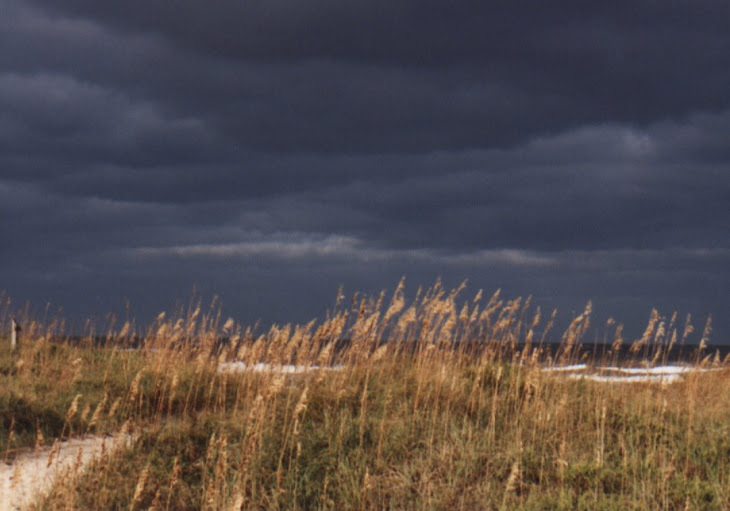
This picture is in the specific area where I plan to focus a good amount of the book - you will learn more about that later :)
These pictures are from the book - which shows pictures during the storm and 25 years later. The pictures that were taken in the same locations 25 years later show how much the area changed and in some cases - how little has changed. These pictures are also featured on this website - http://www.gresham-photography.com/book.html
Monday, December 17, 2007
Lilah and the Locket

The first morning of Kristie’s vacation she jogs along the beach with her German shepherd, Lilah. At the base of the Cape Hatteras lighthouse, Lilah finds a human bone below the sand dune. Kristie’s plans for a quiet week are forgotten as she joins in the investigation. Ocean breezes blow across the Outer Banks of North Carolina and Kristie uncovers a personal connection to the murder victim and her locket.
She meets a handsome government worker named Nathan who is working to complete the National Seashore project in 1954. Do his co-workers know something about the crime? Will Kristie and the Deputy find the guilty party? Join Kristie on the rugged shores of Hatteras in the search for a murderer.
| Description | ISBN # | Price | Availability Date |
|---|---|---|---|
| E-Book Download | 1-59431-475-6 | $4.50 | Available NOW |
| Trade Paperback | 978-1-59431-452-5 | $16.95 | Available NOW |
Saturday, November 17, 2007
Author's Note and Prologue
Author's Note
The Civilian Conservation Corps work mentioned in this story actually took place. In the 1950's, this work was completed and the Cape Hatteras National Seashore opened to the public. Multitudes of people vacation along the Outer Banks of North Carolina each year.
The characteristics the Outer Banks make it difficult to protect the area from nature. They are basically a chain of sand bars along the east coast of North Carolina. The Atlantic Ocean lies on the east and Pamlico Sound lies to the west. At times the ocean water washes into the sound and back to the ocean. This makes the area very vulnerable to bad weather and hurricanes.
The beating surf and fierce undertow cause serious erosion which threatens the coastline. Local inlets shift from south to north with each passing season. Over the years, especially fierce hurricanes have closed some existing inlets while they create new inlets. Hatteras Inlet and Oregon Inlet are the most notable examples.
People and events from real life and my imagination inhabit this story. It offers a glimpse into the rugged coastal experience people enjoy when they visit the Cape Hatteras National Seashore and the Outer Banks of North Carolina. It also illustrates the changes in this stretch of coastline in the last fifty years.
Prologue
Anyone who has read much non-fiction or history about the Outer Banks of North Carolina should be familiar with David Stick. He has written numerous books about the region. These books tell us why this stretch of the eastern seaboard is called the graveyard of the Atlantic. The reader learns about various events and people over several hundred years along with his personal experiences living in this picturesque area.
He is best known as an Outer Banks historian. Many documentary specials about the area contain at least one interview with David Stick. In addition to being a renowned historian, he was also the first licensed real estate broker on the Outer Banks. His company, Southern Shores Realty, was instrumental in developing the town of Southern Shores between 1956 and 1970. This is the same town where he served as mayor.
But, was David Stick the only person in his family to assist in the development of the Outer Banks? If we research back a little further we learn about his father. David Stick followed in the footsteps of his father Frank Stick. In 1929, Frank moved to the Outer Banks. He was an artist and became an entrepreneur on the Outer Banks of North Carolina.
In the 1930's Frank Stick knew Dare County was on the brink of bankruptcy. He wasn't the kind of man to stand back and watch the area go belly up. Love for the area prompted his desire to discover a way to regenerate the Outer Banks in addition to finding a way to protect and preserve the natural beauty of the area. Was there a way to bring in tourism revenue while still being able to preserve the things he loved about the area?
One of the biggest problems on the Outer Banks was transportation and the difficulty in getting from one area to another. To remedy this immediate problem, better roads and more bridges were needed. In truth, any paved roads would be a big improvement. Travelers were met by sandy paths which led in all directions and many went in circles. Many areas along the lower Outer Banks were isolated from the upper Outer Banks and the mainland. Bridges were a more effective way to connect the barrier islands which make up the Outer Banks. Sporadic and slow ferry service could only transport a limited number of people per day.
The barrier islands presented various difficulties. These flat and low-lying sandy islands had no protection from the rough surf that eroded the sand and would wash out any new roads.
Frank Stick worked with Washington Baum and they made some progress. Mr. Baum chaired the Dare County Commission and could help the project. In 1928 a toll bridge linked Manteo and Nags Head. This allowed people to travel from the mainland to the beach. Soon, a toll bridge connected lower Currituck County and Kitty Hawk. This provided two routes for tourist to reach the upper portions of the Outer Banks. Although, there was still no good way to access the lower section around Buxton, Hatteras and Ocracoke.
In 1933, Frank Stick unveiled his plan. Cape Hatteras would be the focal point of a National Seashore that would extend over 100 miles. It would begin just south of the Virginia state line and extend past Cape Lookout, NC. The small villages scattered along the coastline would remain separate from the National Seashore. Several wildlife refuges were located throughout the area.
The first paved highway would extend the full-length of the seashore and bridges would link the islands in order for tourists to experience everything the area had to offer. Large sand dunes could provide protection for a paved road and would be aesthetically pleasing. Bridges would provide a better way to link the islands. The plan offered a chance to increase tourism and provide thousands of jobs.
What better time to promote this idea, than in the middle of a nationwide economic depression? The government saw the plan as a wonderful way to provide employment for thousands and they bought existing bridges in the area and removed the tolls. The Cape Hatteras National Seashore Commission bought land needed for the project. There was some animosity about how this was handled by people who owned property in the area which would become the National Seashore.
Frank Stick headed various projects on Hatteras and Ocracoke Islands. One of the first priorities was to build 115 miles of sand dunes to protect the islands and future roads. The project required 600 miles of fence, 140 million square feet of grass, with two and a half million small bushes and shrubs to build the dunes and anchor them against the forces of nature that would assault them. When the dune line was complete, they built paved roads.
During this time, the United States was experiencing a major economic depression. Untold numbers of people were unemployed in 1932. The people of the United States were desperate for some relief and they needed to find work.
New York governor Franklin D. Roosevelt planned to protect the environment, by putting the masses of unemployed people to work. He called an emergency session of the 73rd Congress to announce his plan. Thousands of unemployed young men joined the peacetime army to fight the destruction of our natural treasures. Over three million men worked on the various projects.
Work camps were set up and myriads of young men traveled to areas of the country for specific types of work. The Civilian Conservation Corps were born. This story focuses on one project: the creation of the Cape Hatteras National Seashore in North Carolina.
I've been reading a lot about how the seashore came into being and it was a fascinating time with a wide variety of people who were involved. There were different reasons why these people worked to help the seashore be formed. But, I think that is a story for another time.
Before the project could be completed, World War II broke out in Europe. The war forced the United States government to shift its focus. One of the many projects they abandoned was the Cape Hatteras National Seashore. The government workers returned to complete the project in the 1950's.
Subscribe to:
Posts (Atom)